·10 min read
Unlocking $750B in Idle Bitcoin: Introducing the Native Bitcoin Vaults Stack

Dominik Harz
Co-founder at BOB
Native Bitcoin Vaults turn idle BTC into productive capital: users can borrow stablecoins and earn yield in DeFi while their BTC collateral remains natively secured on Bitcoin.
Tl;dr:
- Less than 0.35% of all BTC is used in native Bitcoin DeFi—compared to ~30% of ETH deployed across Ethereum DeFi and staking. Closing that gap is a 100× opportunity, unlocking over $750B of Bitcoin liquidity onchain.
- Native Bitcoin Vaults turn idle BTC into productive capital: users can borrow stablecoins and earn yield in DeFi while their BTC collateral remains natively secured on Bitcoin.
- BOB is building an open-source Native Bitcoin Vaults stack with configurable security assumptions, fast and reliable liquidations, and seamless integration into existing DeFi protocols.
- Launching in early 2026, Native Bitcoin Vaults will integrate directly with permissionless lending markets such as Aave v4, Morpho, and Euler—initially secured by institutional operators, and upgraded to fully on-chain security via BitVM in mid-2026.
What Are Native Bitcoin Vaults?
Today, we’re announcing the Native Bitcoin Vaults Stack: open-source infrastructure that lets you use Bitcoin as DeFi collateral—without giving up custody.
Native Bitcoin Vaults let you use your BTC as collateral for loans—without handing it to a third party and without your coins ever being pooled with anyone else’s.
- Deposit. Lock your BTC directly on the Bitcoin network and receive a token on BOB that represents that exact deposit.
- Borrow. Borrow stablecoins or use the locked BTC as collateral for trading derivatives or in other bespoke DeFi products - on BOB, Ethereum, Base and other chains or platforms.
- Repay. Repay your loan to get your Bitcoin back. Not any coins - exactly the coins you locked.
After a decade of searching, this is finally becoming a reality thanks to BitVM. Not just in theory, but on Bitcoin mainnet in 2026. Just two weeks ago, BOB reached a key milestone: we shipped the cheapest BitVM3 verifier to date, bringing proof costs below $11.
The Problem
Bitcoin represents over $2 trillion in value, yet less than 0.35% participates in native Bitcoin DeFi. By comparison, roughly 30% of ETH is actively at work—staked, earning yield, serving as collateral, powering financial applications. That’s a 100x gap: more than $750 billion in idle Bitcoin capital is waiting for infrastructure that meets Bitcoin holders’ requirements.
Today’s solutions force painful tradeoffs:
- Centralized lenders take full control of your assets, requiring absolute trust in their operational competence and legal compliance. Simple—and often effective—until it isn’t.
- BTC wrappers in DeFi provide transparency, security, and composability—but only for the wrapper token. The underlying BTC remains in centralized custody. Redemptions are frequently slow or restricted, coins are pooled (and potentially tainted), and minting or receiving a new token can introduce tax and accounting complications.
The result: most serious Bitcoin holders keep their BTC on the sidelines.
How It Works
Native Bitcoin Vaults preserve what matters—your exact coins and your custody guarantees—while enabling DeFi-style liquidations: atomic when possible, fast when not, open to any liquidator, and partial by default.
The core promise is simple: borrow against your Bitcoin and get your exact coins back—something no BTC wrapper can offer. This is enforced through a covenant-based vault design using pre-signed transactions that strictly limit how BTC can be spent, directly on the Bitcoin network.
We provide a simplified overview below— a full specification will be released soon.
Roles
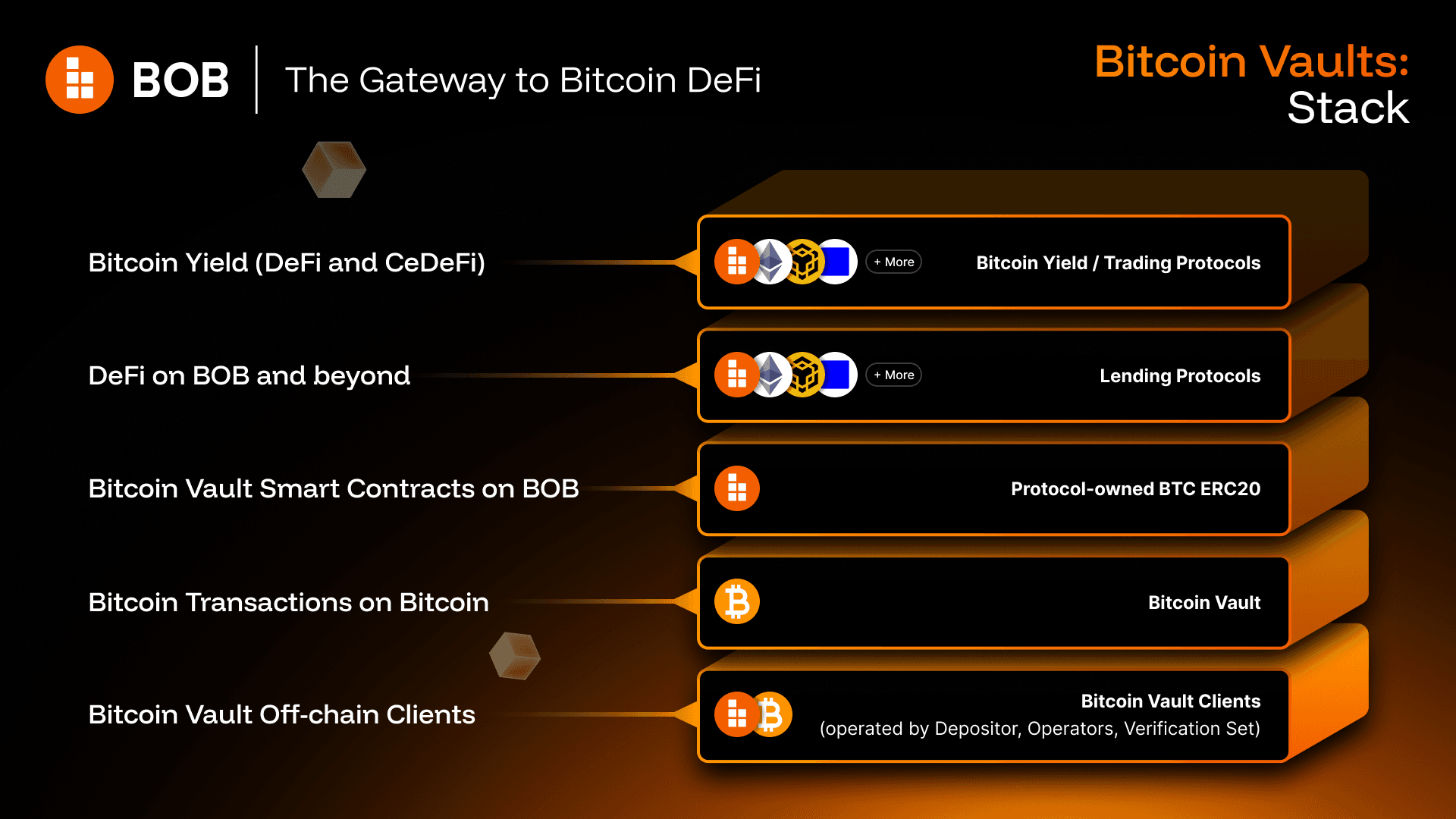
- Depositor. Locks BTC in a vault to borrow stablecoins and/or earn yield. Repays loan to claim locked BTC, or defaults and is (partially) liquidated.
- Lender / DeFi protocol. Lends stablecoins with repayment guaranteed by the locked BTC. Can also be a DeFi lending protocol, or trading platform accepting BTC as collateral.
- Liquidators. Repay bad debt on behalf of the depositor if collateral thresholds are breached and receive BTC at a discount.
- Operators. Core infrastructure runners that help enforce protocol rules. Run vault setup, initiate liquidations when collateral ratios are breached and can trigger dispute handling if either side misbehaves. Don’t take custody of the BTC.
- Tribunal. Steps in when withdrawals or liquidations are disputed. Can be implemented as a BitVM instance for trustless enforcement, or as an impartial multisig signer set, e.g. for institutional use cases.
Protocol steps
1. Deposit. The depositor locks BTC on Bitcoin by sending them to the "deposit vault” address. Once in the vault, the BTC can only be spent in two ways via special, pre-defined transactions:
- Withdraw. Sends BTC back to the depositor, after a delay (timelock). Published by the depositor.
- Liquidate. Send to the liquidation address, after a delay (timelock). Published by operators.
Both of these transactions can be intercepted within the delay period in case of a dispute (see "Dispute” below). Funds can be also split between the two in case of partial liquidations.
2. Borrow. Once the deposit is completed on Bitcoin, the BTC can be used in DeFi applications e.g. on BOB.
3. Withdraw. The depositor repays the loan / closes the DeFi position and initiates a withdrawal to their deposit address on Bitcoin. After the timelock expires (no disputes), the BTC is credited to the depositor.
4. Liquidate. The vault was liquidated in the DeFi protocol (e.g. depositor defaulted on the loan). The liquidating party now has a claim on (part of) the BTC locked in the vault. The operators initiate a BTC withdrawal to the liquidation address on Bitcoin. After the timelock expires (no disputes), the BTC lands in the liquidation address.
Liquidated funds go directly to (a) the liquidator or (b) to a bridge deposit address of a BTC wrapper like wBTC and are claimed by the liquidator on the chain where the respective DeFi protocol is deployed.
5. Dispute. By design, both depositor and operator can initiate BTC withdrawals from the vault at their discretion. As a result, disputes may arise due to attempted attacks on the protocol, e.g. attempting to withdraw while the lending position is open or wrongful liquidations. In case of a dispute, either party (depositor or operators) can intercept the withdrawal transaction before the end of the timelock - and move the BTC into the Tribunal.
The Tribunal verifies the correctness of the withdrawal request and ultimately sends the BTC to either the depositor or liquidator. The composition of the Tribunal (BitVM or multisig) determines the core security assumptions of the protocol (more below).
Tools & Primitives
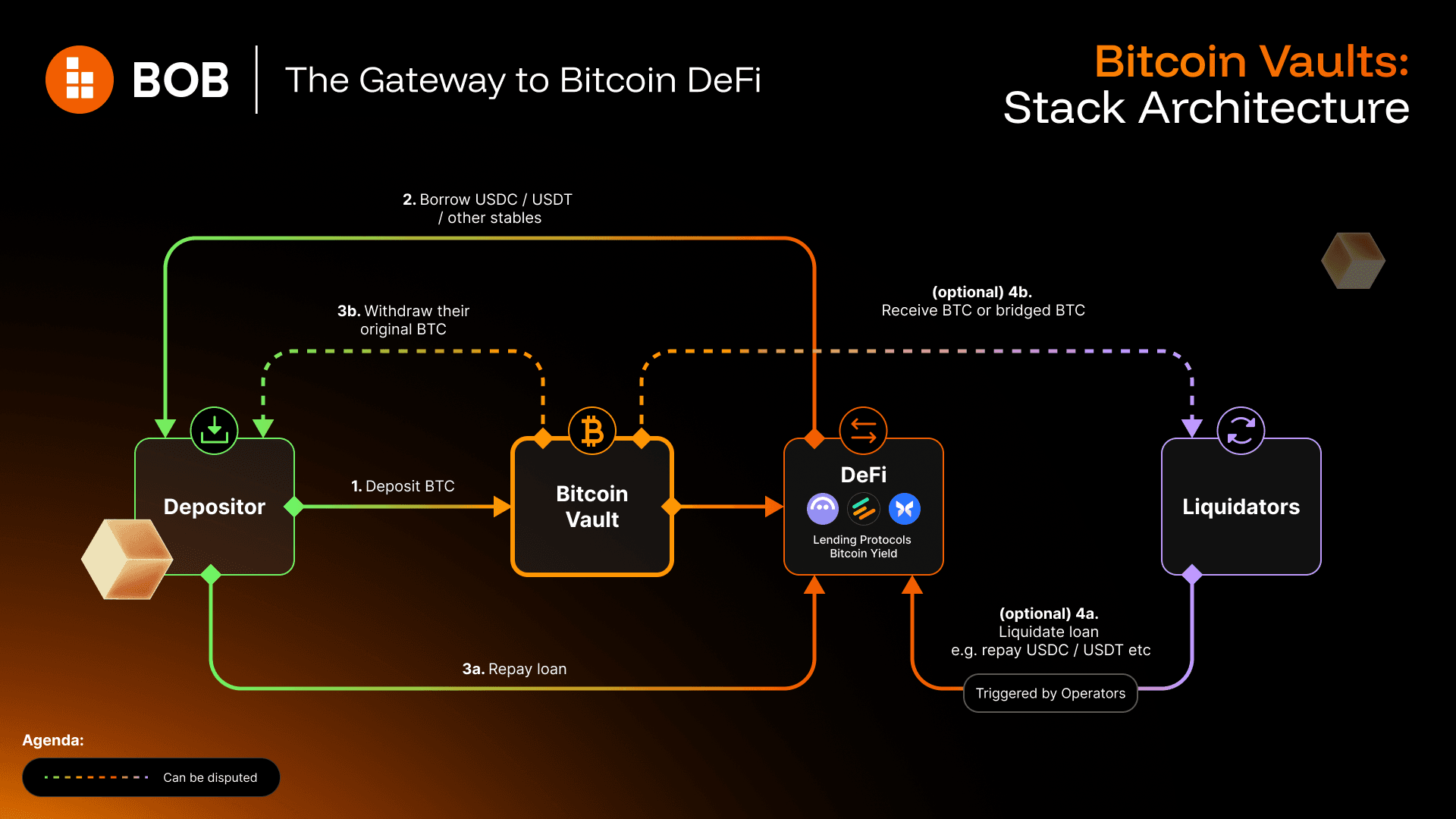
Native Bitcoin Vaults are a combination of Bitcoin Script primitives, off-chain coordination and key-sharing protocols as part of BitVM, and EVM smart contracts logic on the BOB chain.
Bitcoin
Spending restrictions are enforced via covenant emulation and pre-signed transactions (PSBTs).
- Covenant emulation via PSBTs (pre-signed Bitcoin transactions). As part of the protocol, we must enforce transfer restrictions on the deposit vault on Bitcoin, such that BTC can only be spent using specific transactions (which in turn can be intercepted). Such transfer restrictions are referred to as "covenants” in Bitcoin - and do not yet exist natively. Until then, we emulate this logic using a n-of-n multisig committee (1 honest participant suffices for security, can be the depositor) and PSBTs.
- BitVM. Novel Bitcoin paradigm that allows us to execute arbitrary programs on Bitcoin using optimistic computation - programs are run off-chain or on other chains, results posted to Bitcoin and challenged if incorrect. See the award-winning BitVM2 paper and the latest protocol iteration BitVM3.
BOB
-
Bitcoin light client. A smart contract that tracks the Bitcoin blockchain and programmatically verifies Bitcoin transactions.
-
Protocol-owned ERC20 with transfer restrictions. While BTC positions are tracked for each depositor, compatibility with existing DeFi protocols is achieved via a protocol-owned ERC20. Meaning, the token can be sent only to a set of whitelisted smart contracts by the protocol itself. The ERC20 is used only for internal protocol logic and depositors never interface with it directly.
Liquidations
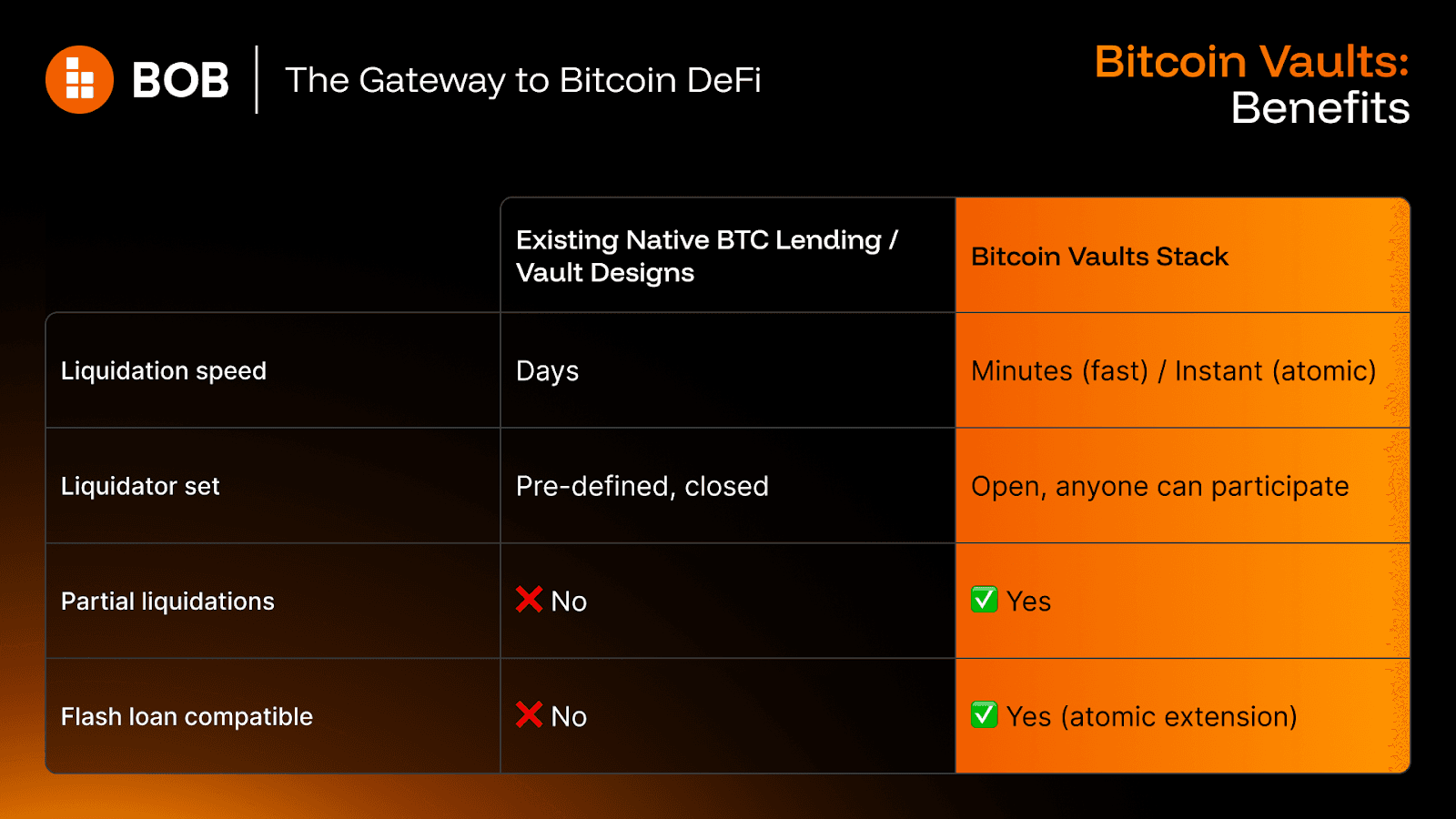
One of the hardest problems of native BTC lending is ensuring secure liquidations for DeFi. Not only must we ensure BTC gets delivered to liquidators, we must also make sure it happens fast and that anyone can perform liquidations. The Native Bitcoin Vaults Stack abstracts away Bitcoin's complexity to make liquidations work exactly like existing DeFi:
- Open liquidator set. Anyone can participate in liquidations.
- Partial liquidations. Return loans to safe LTV ratios without liquidating entire positions.
- Fast settlement within minutes, or even instantly enabling flash loan liquidations, just like on Ethereum
- Easy integration, ensuring DeFi protocols do not need to change protocol logic.
For full technical details on how Native Bitcoin Vault liquidations work, see BOB's liquidation engine paper.
Flexible Security Parameters
The Native Bitcoin Vault Stack follows a modular design and allows to set custom parameters and plug-and-play different components - allowing businesses and DeFi protocols to customize the vaults to their product and security needs.
Operators. The set of operators can be freely chosen per vault instance. The initial design will use native Bitcoin multisignatures supporting up to 15 signers. Larger signer sets will be supported in the future via off-chain MPC/TSS schemes. Two further parameters are the thresholds of operator signatures required to trigger a liquidation and to challenge a dispute. This can range from a single operator for speed and increased security, up to a n-of-m signature threshold to reduce false positives and risk of DOS attacks.
Tribunal. Similarly, the design and composition of the Tribunal can be chosen freely. The Native Bitcoin Vaults Stack will support two primary operation modes:
-
Multisig Committee. Initially, the Tribunal will be implemented using a multisig committee of institutional operators. In this design, secure dispute resolution relies on the honest majority of the Tribunal members (thresholds are subject to parameterization). This is comparable to existing wrapped BTC solutions, with a critical difference—if you repay your loan, you can withdraw your BTC (your specific coins) without any multisig involvement. If the committee goes offline entirely, timelocks in the vault setup ensure depositors can recover their BTC after a timeout period. Your funds are never stuck.
-
BitVM. BitVM is a system that enables smart contract-like logic on Bitcoin through fraud proofs—similar to how optimistic rollups work on Ethereum. With BitVM, the multisig committee is replaced by cryptographic verification: anyone can challenge an invalid claim, and correct execution is proven mathematically. Trust assumptions drop to 1-of-n—meaning only one honest participant is needed to keep the system secure.
At launch, BOB Hybrid Node operators, composed of institutions and node/staking operators, will serve as a publicly available Tribunal setup. Verification and dispute resolution is automated and requires no manual intervention but handled off-chain — on-chain enforcement ultimately requires BitVM.
BOB has been at the forefront of BitVM development since its inception, contributing to research, specification and implementation. We co-authored the award-winning BitVM2 design and bridge paper, are active contributors to the BitVM Alliance, and lead the institutional bitvm/acc working group. Most recently, we shipped the cheapest BitVM3 onchain verifier to date, with proof costs under $11. Today, BitVM is live on BOB's testnet, operated by institutional operators (Hybrid Nodes) and we are on track for a mid-2026 mainnet rollout as part of the Native Bitcoin Vaults Stack.
Opportunities
Bitcoin holders:
- Use BTC as collateral without bridges and wrappers
- Get exactly your BTC back: no risk of mixing/tainting funds
- Avoid tax and regulatory challenges with wrappers
Institutions (custodians, lenders, funds…)
- Offer BTC-backed credit and yield products that are fully onchain, auditable, and UTXO-segregated
- Users retain BTC on your platform
- Customize setup and trust model to fit your needs, from institutional to fully on-chain via BitVM
DeFi protocols:
- Add native BTC collateral and tap into a $750B market, as simple as listing another ERC20
- Reuse existing liquidation bots, risk engines, and monitoring infrastructure
- Customize trust and risk management to fit your needs
Staking operators and market makers:
- Run operators / Hybrid Nodes on BOB, earn BTC fees
- Run liquidations as a service]
Why BOB?
Native Bitcoin Vaults require two things: Bitcoin verification and deep stablecoin liquidity.
- Verifying native BTC deposits requires a Bitcoin light client
- Borrowing against BTC only works where stablecoins actually exist
Ethereum and its L2s have the deepest stablecoin liquidity in crypto — USDC, USDT, and the infrastructure to move them. But they lack Bitcoin tooling and infrastructure to enable native BTC access.
BOB's Hybrid Chain solves this trade-off.
- As an Ethereum L2 with validity proofs, BOB inherits Ethereum’s security while offering dramatically lower transaction costs
- Bitcoin light client operations run at a fraction of mainnet cost
- Native bridges give direct access to USDC, USDT, and the broader Ethereum stablecoin ecosystem
- Users can always verify BOB’s state and exit to Ethereum if needed
The result: Bitcoin security for collateral, Ethereum security for execution, and Ethereum liquidity for loans.
What's Next
Native Bitcoin Vaults will launch on BOB mainnet in early 2026, initially secured by a set of institutional operators composed of BOB Hybrid Nodes.
By mid-2026, the stack advances to full trust minimization with the BitVM3 upgrade. The Tribunal evolves from institutional multisig security to cryptographic enforcement directly on Bitcoin.
In parallel with the protocol rollout, we are onboarding permissionless lending markets, vault operators, trading protocols, custody providers, and node runners to ensure liquidity, resilience, and operational readiness at mainnet scale.
The 100× opportunity in Bitcoin DeFi will not unlock itself.
Native Bitcoin Vaults are a core building block in BOB’s roadmap to banking on Bitcoin—enabling native BTC lending as the foundation for credit, payments, and capital markets secured by Bitcoin itself.
For technical details on the liquidation engine, see our research paper. For more on BOB's vision, read The Vision for BOB: Your Money, Powered by Bitcoin.

Dominik Harz
Co-founder at BOB
10 years smart contracts, stablecoins & DeFi R&D. Computer Science PhD from Imperial College. Previously cybersecurity at PWC, BinanceX Fellow.