·6 мин чтения
The Real State of Bitcoin DeFi: DeFi Dad & Nomatic on Lending, Swaps, and STRC

Petra Poliaková
Events Manager
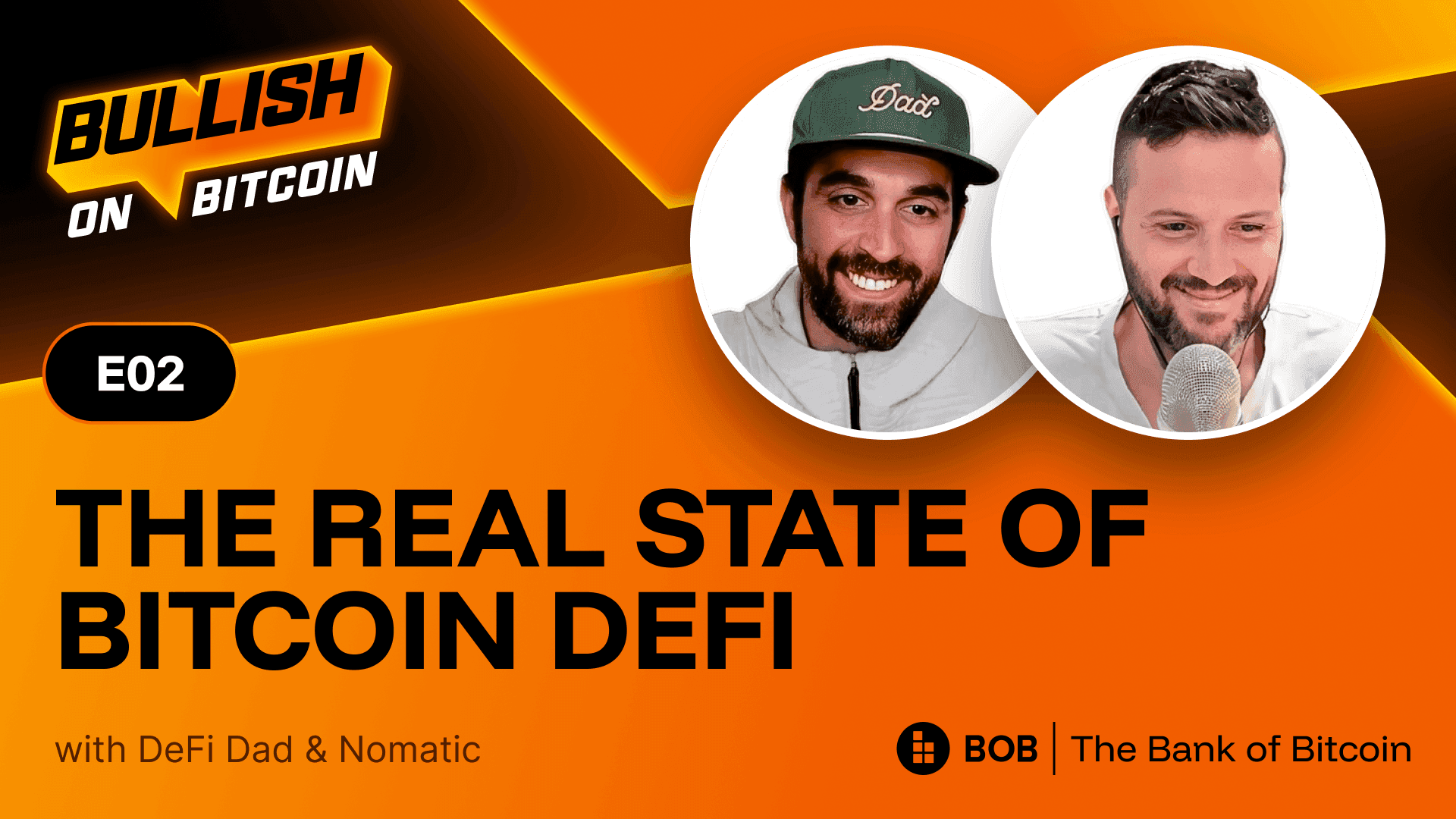
DeFi Dad and Nomatic join Alexei Zamyatin to unpack Bitcoin-backed lending, why BTC trades so little on-chain, and Strategy's STRC yield product.
In episode two of the Bullish on Bitcoin Show, BOB co-founder Alexei Zamyatin welcomed two of DeFi's best-known educators — DeFi Dad and Nomatic, co-hosts of The Edge podcast — for a wide-ranging, occasionally spicy conversation about where Bitcoin DeFi actually stands today. The premise Alexei put on the table at the outset: Ethereum has had years of DeFi summers to build out its ecosystem, while native Bitcoin has struggled to find its place in DeFi at all. So — is Bitcoin DeFi real, is it dying, or is it just getting started?
Here's a rundown of the highlights.
Has Bitcoin Really "Failed" at DeFi?
DeFi Dad pushed back on the framing right away. In his view, Bitcoin hasn't failed — it has simply played a different role: store of value, digital gold, and the collateral backbone underneath a huge share of DeFi activity on Ethereum and other chains, largely through tokenized versions like WBTC. He pointed to Bitcoin's predictability, resilience, and censorship resistance as exactly the properties that made it valuable as collateral in the first place, even if that means most of its DeFi utility today happens somewhere other than its own base layer.
Nomatic framed the constraint more structurally: Ethereum was built from day one to be programmable, while Bitcoin wasn't, and every attempt to bolt programmability on afterward runs into both technical limits and internal disagreement about direction. Still, he saw a silver lining in that constraint:
"I actually think with constraints come some amazing innovation... you're just looking at the problem so differently with less tools almost."
Alexei described BOB's own approach to working within these constraints: rather than trying to change Bitcoin, move as much of the application logic as possible onto Ethereum and treat native Bitcoin primarily as an asset. Increasingly, that means avoiding traditional wrapping altogether — for trading, users can swap directly from a hardware wallet without ever holding a wrapped token, and for lending, purpose-built protocols can let Bitcoin serve as collateral without needing a fully fungible wrapped asset. As he put it, you trade away some generality for a lot more security and simplicity.
Why Isn't More BTC Actually in DeFi?
With over half of all Bitcoin sitting idle in self-custodial wallets and only a sliver in DeFi or wrappers, the panel dug into why adoption has been so slow. DeFi Dad's read was that Bitcoin holders — historically a more risk-averse, "not your keys, not your coins" crowd — watched a string of centralized lending blowups in 2022 and became understandably cautious about handing custody to anyone. What's changed his mind somewhat is products like Coinbase's one-click Bitcoin-backed borrowing: DeFi mechanics running invisibly behind a simple, KYC-free, no-gas front end that ordinary users can actually use.
That led into a broader debate about "DeFi with customer service." Nomatic argued there's nothing stopping decentralized protocols from offering the same polish — email sign-in, cloud-based key storage, no twelve-word seed phrases — pointing to platforms like ether.fi as proof that the hardline, fully-immutable DeFi ethos and the more usable, semi-custodial version can coexist as different points on a trust spectrum. Alexei agreed, adding a generational observation:
"The younger generation doesn't want to deal with this... the older generation, for them, it's too complicated. I think the majority of the population will be happy to have... a semi-custodial setup where social recovery and there is some trust involved, but it's not like you're giving away full custody."
All three agreed the common thread — whether hardline or user-friendly — is that on-chain activity is inherently more auditable and transparent than centralized alternatives, with DeFi Dad pointing out that FTX-style fund siphoning simply isn't possible when liabilities and flows are visible on-chain in real time.
Lending: Coinbase's Mortgage Play and the Liquidation Problem
A major thread of the conversation centered on Coinbase's new product letting users borrow against Bitcoin for a home down payment — up to 20% of a mortgage, with the rest financed conventionally. DeFi Dad, who once borrowed against Bitcoin on Aave to help buy his own home during the early 2021 bull run, called this a meaningful step up in legitimacy: rather than serving a narrow pool of crypto-native borrowers, Bitcoin-backed lending is starting to reach mainstream financial products that "rewire people's brains" about what these assets actually are.
Alexei raised a sharper concern: liquidation risk is still the single biggest psychological barrier to mainstream Bitcoin lending adoption. His proposed fix is to hide the borrowing mechanic inside something that doesn't feel like debt — similar to how credit cards obscure the emotional weight of taking on a loan compared to, say, pawning a family heirloom. He argued the ideal setup pairs long-horizon capital providers who are bullish on BTC with borrowers who never face margin calls:
"If you either package it in a smart way where it's self-repaying... or you find capital providers that are bullish on BTC... this is like how we do Bitcoin loans now. So you won't get liquidated."
DeFi Dad backed this up with a concrete number: Coinbase was quoting roughly 4.5% to borrow USDC against Bitcoin or ETH at the time of recording — a fraction of typical credit card APRs — making a compelling case that responsible borrowers have little reason not to tap this kind of liquidity rather than continuously chasing the elusive goal of buying enough BTC outright.
Why Doesn't Bitcoin Trade On-Chain?
Alexei posed one of the episode's sharpest questions: Bitcoin is the most-traded digital asset in the world, with roughly $800 billion in monthly exchange volume, yet on-chain Bitcoin trading — through wrapped-asset DEX trading and native cross-chain swaps combined — totals only somewhere in the range of $18–20 billion a month, with native (non-wrapped) swap volume closer to just a couple billion. Wallet support for Bitcoin has expanded dramatically over the past five years, so why hasn't liquidity followed?
Nomatic's answer leaned on history and infrastructure: early Bitcoin culture was famously resistant to embracing Ethereum-style tooling, and deep liquidity — the kind that lets large holders trade without eating painful slippage — simply takes years to build, something Ethereum has had a head start on. DeFi Dad added that Ethereum's native asset never carried the counterparty risk that any wrapped or bridged version of Bitcoin inherently does, which has kept large holders anchored to centralized venues with professional market makers.
Alexei agreed liquidity is a real constraint but argued the more solvable, more immediate problem is Bitcoin's ten-minute block time — a delay that makes on-chain trading feel fundamentally different from the instant execution traders expect elsewhere. He pointed to BOB's own work separating settlement from execution, letting users get a locked-in rate and their assets immediately rather than waiting through a confirmation window, as a concrete step toward closing that gap. DeFi Dad, in turn, flagged the flip side of the same problem: moving Bitcoin collateral seamlessly between different L1s and L2s remains surprisingly unsolved industry-wide, a gap he was glad to hear BOB's Gateway product is actively addressing.
A Quick Take on STRC
With time running short, the conversation turned to Strategy's STRC ("Stretch") product — a high-yield instrument paying an 11.5% annualized dividend, used to fund further Bitcoin purchases. Alexei staked out a skeptical position, noting there's no guarantee the dividend continues if fresh capital dries up. Nomatic offered a more constructive framing: unlike opaque private credit products currently under stress in traditional finance, STRC's collateralization can be audited daily, and holders retain the ability to exit the position — a level of transparency he argued most legacy credit products can't match. Both agreed it's a product worth watching closely rather than one to take blindly on faith — and, as DeFi Dad noted, wherever DeFi activity surges, Bitcoin usually turns up somewhere in the strategy, whether as direct collateral or the capital behind it.
Watch the Full Episode
This recap covers the main threads, but the full conversation goes deeper on wrapped assets, DeFi options markets, and the philosophical debate between hardline and user-friendly DeFi design. Watch the complete episode of the Bullish on Bitcoin Show with DeFi Dad & Nomatic here: