·4 分钟阅读
The CEX hop is the most expensive step in crypto

Maria Nimfuehr
Growth marketing lead
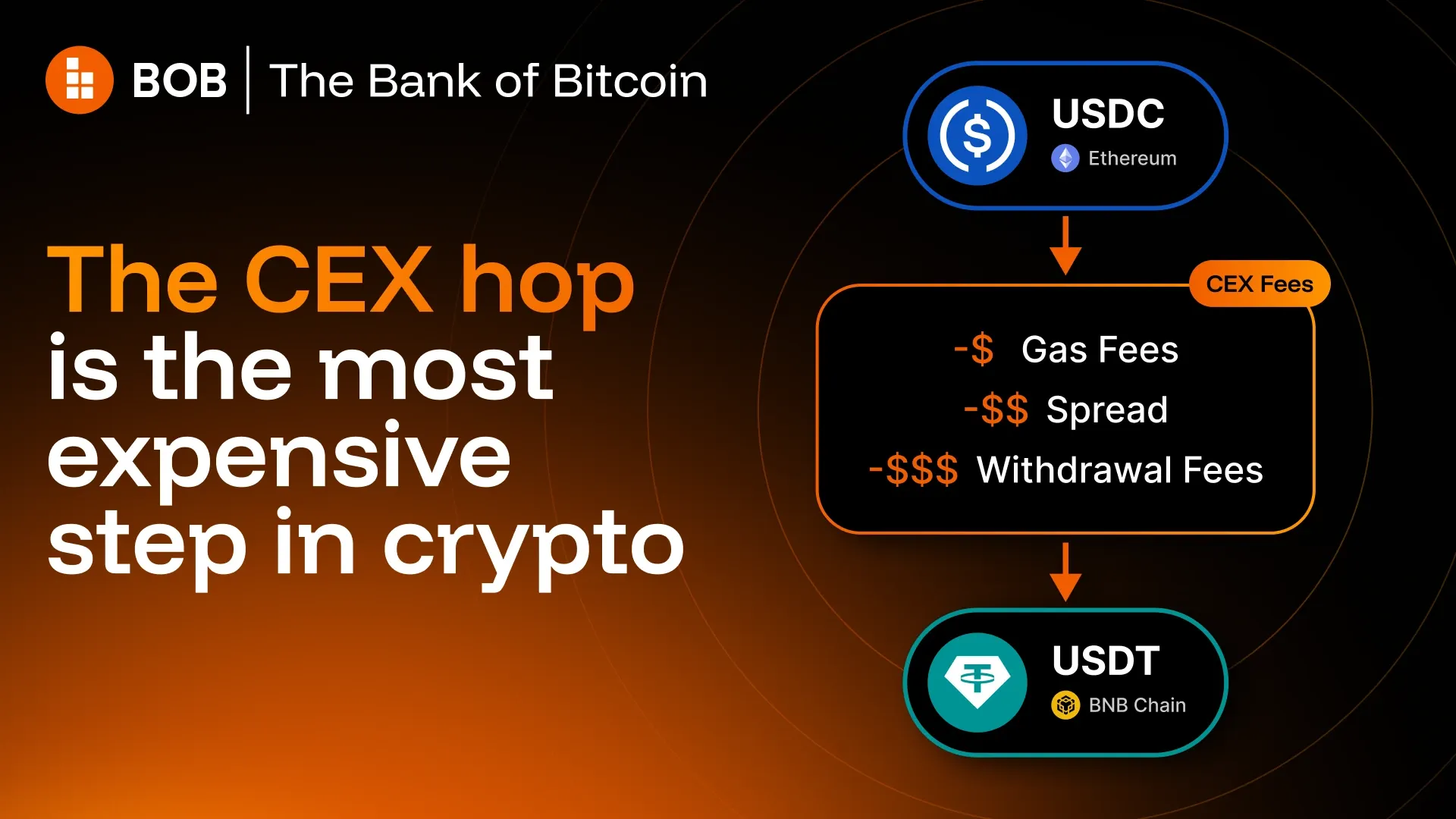
Why bridging and swapping USDC and USDT across chains shouldn't (always) route through an exchange.
You hold USDC on Ethereum. The thing you want to do lives on BNB, and it wants USDT.
So you withdraw to a CEX, paying gas to get there. You wait for deposit confirmations. You convert, paying a spread. You withdraw again to a different chain, paying a flat withdrawal fee that doesn't care how much you sent, and you wait again. Then you go back to whatever you were trying to do in the first place.
That's the route most people take. It's also the route where most cross-chain flows die. To solve that, BOB Gateway now allows users to easily bridge and swap USDC and USDT across chains in a single action, without a CEX.
Stablecoin swaps and bridges made easy
Stablecoins now move across more chains on BOB Gateway. USDC and USDT, bridged and swapped between Ethereum, Arbitrum, Base, BNB and Avalanche - including crosschain swaps of USDC to USDT. One action, no CEX hop, no withdrawal fee and no separate swap once the funds arrive.
Stablecoin bridges and swaps come in two flavours:
- Same-asset bridges, where USDC on Ethereum becomes USDC on Base and USDT on Arbitrum becomes USDT on BNB.
- Cross-chain swaps, where USDC on Ethereum becomes USDT on Avalanche - the asset conversion and the chain change happening together rather than as two separate problems you solve in sequence.
The live set of route coverage is documented on the supported routes page, which renders directly from the API, so it's accurate at the moment you read it.
CEX hops are slower and more expensive
So why is a CEX hop a problem? When you are using a centralized exchange, you have to deal with several shortcomings:
The hop breaks custody
For the duration of the hop, your money belongs to an exchange. Not to you.
That's fine right up until it isn't. Withdrawals get paused during volatility, network upgrades and compliance reviews. You can find out your funds are stuck at precisely the moment you wanted to use them, which is not a coincidence - the conditions that make you want to move money quickly are the same conditions that make exchanges slow (or even shut) down.
It gates on access, not on capability
A user in a country where the major exchanges don't operate can't do the hop at all. Neither can a user whose exchange never listed the destination chain, which is the normal state of affairs for anything newer than about two years old. So "just use a CEX" often means "this route exists for some users and not others."
It costs more and takes longer
CEX transactions are more expensive than they seem:
Gas to send. Then a withdrawal fee, usually flat. On a $2,000 transfer a $3 flat fee is noise. On $80 it's nearly 4%. Add a spread if the exchange makes you convert rather than doing a like-for-like withdrawal, and small transfers get eaten alive by the plumbing.
They can also take longer: Deposit confirmations, a withdrawal queue, sometimes a manual review that can take from ten minutes to several hours. The stablecoin isn't going anywhere, but the reason you were moving it is. Collateral you needed to post before a position got liquidated. A dip on the other chain. A lending rate that was good this morning. Those have a clock on them. The withdrawal queue doesn't.
Where the exchange still wins - and what that costs
Worth saying plainly, because the counter-argument is real. The CEX route has deep liquidity and predictable pricing at size. It also has no smart contract risk.
If you're moving significant sums and execution price is the binding constraint, the exchange can still be the rational choice. However, at that size you aren't avoiding risk, you're picking which kind you'd rather hold: contract risk, which is published and audited and you can go read, or counterparty risk, which is a balance sheet you were never allowed to see. Bigger position = bigger custody exposure. FTX was the most liquid venue in crypto right up until the morning it wasn't.
For the median user moving a few hundred dollars, the argument doesn't get that far. The CEX path is slower, proportionally more expensive, conditionally available - and it hands over custody anyway.
One balance, not seven
A stablecoin is supposed to be the boring part of your portfolio. The thing you hold when you don't want to think about it.
Then it turns out yours is on the wrong chain, and thinking about it becomes a forty-minute errand involving a third party you don't control.
You hold USDC on Ethereum. The thing you want to do lives on BNB, and it wants USDT. That should be one action.
Frequently asked questions

Maria Nimfuehr
Growth marketing lead
Marketing and GTM engineer at BOB. Previously at Lisk. Mentor at Techstars.