·5 分钟阅读
Everybody Aggregates Everybody: Socket's Vaibhav Chellani on the Crosschain Swap Endgame

Maria Nimfuehr
Growth marketing lead
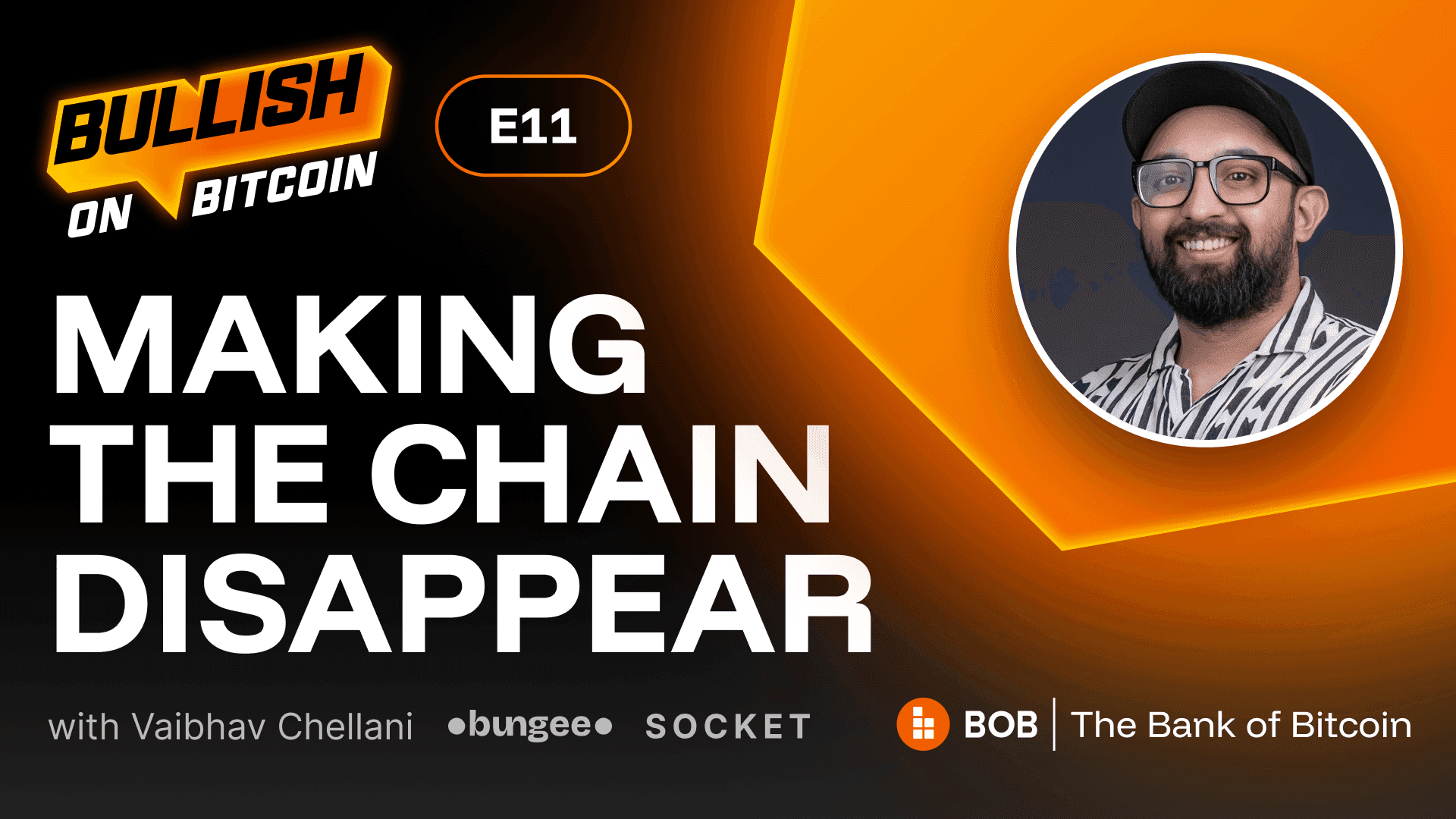
Socket co-founder Vaibhav Chellani and BOB's Alexei Zamyatin on cross-chain swap aggregation, solver economics, and why quotes still lie to users.
In the latest episode of the Bullish on Bitcoin Show, BOB co-founder Alexei Zamyatin sat down with Vaibhav Chellani, co-founder of Socket and Bungee, for a wide-ranging, forward-looking discussion on the evolution of blockchain infrastructure. Known for his early work scaling Ethereum at Polygon and building ZK roll-ups with the Ethereum Foundation, Vaibhav has been at the forefront of cross-chain technology for years.
The central theme of their conversation: how do we make chains disappear for the end user? Alexei and Vaibhav explored the transition from a fragmented, multi-chain landscape to a "chain-abstracted" future where users interact with applications rather than infrastructure, and where the next generation of web3 giants - the Googles and Facebooks of crypto - will be built.
Here is a rundown of the highlights from their discussion.
Everyone aggregates everyone, and nobody is neutral
Alexei laid out the state of play. At the bottom you have Circle and LayerZero routing their own assets. On top of them sit protocols like Socket, competing on routing. On top of those sit aggregators promising the best route across all of them. Then the protocols started aggregating each other. Then meta-aggregators like Oku and Enso arrived to aggregate the aggregators.
So who actually picks the route? Nearly everyone doing the picking also runs a protocol that pays them when it wins. That's not a conspiracy, it's just the org chart. But it does make “best route” a phrase worth reading twice.
“Aggregation is the how. It is not the why.”
Vaibhav's answer was to reject the premise that crosschain routing is a price problem at all.
The industry, he argued, borrowed its mental model wholesale from DEX aggregation and never checked whether it fit. It doesn't. A same-chain swap is atomic. A crosschain swap is asynchronous - it starts on one chain and finishes somewhere else, minutes later, and a lot can go wrong in between.
“I think that in asynchronous processes, the reliability matters a lot more than the price.”
Which makes the entire optimization target wrong. As he put it, chasing the last $0.001 is not adding that much value to society. Socket optimizes instead for surfacing the right signal - latency, reliability, security, and yes, price - and extends the same logic across swaps, transfers and on-ramps. On-ramping $10 from India should not route the same way as $1,000. Same wallet, same asset at the end, different path.
“Aggregation is the how. It is not the why someone would use this thing.”
Why aggregators keep eating downward
There's an unglamorous reason the market keeps folding in on itself, and it's the P&L.
Aggregation is a wonderful way to scale and a terrible way to make money. Want to launch on a new chain? Bundle in an existing provider, add a fee, ship it by Friday. But most of what you collect goes straight back out to the underlying provider. Easy to scale, hard to monetize. So the moment an aggregator has real volume, it walks down the stack to keep more of the revenue it's already generating - which is exactly why so many aggregators have quietly become protocols.
Meanwhile the pressure runs in the other direction too. Alexei pointed to Ledger, one of the largest sources of Bitcoin flow in crosschain swaps, which works with aggregators and also does direct integrations. Every direct integration removes a middleman. Aggregators know which middleman it is.
The network effects test
Asked how any of this shakes out, Vaibhav offered the cleanest heuristic of the episode:
“If you don't have network effects on the infrastructure side, you should launch a B2C app. If you have network effects on the infrastructure side, you should go really hard on B2B.”
Bootstrapping an order book has network effects. Stacking licenses across geographies has network effects. Writing clever code does not - and he had the receipts: Socket rewrote its backend in three days and shipped it to production with no bugs. If his team can do that, so can everyone else's.
Alexei agreed, and put it less kindly. The technological moat is going away. What's left is trust and user relationships, which crypto has historically been bad at, having spent a decade building infrastructure for infrastructure. The people making money are the wallets and the apps. They pick their providers, not the other way around.
Vaibhav's framing: the infra era is ending and the app era is starting, and the shutdowns everyone is depressed about are the cleansing that makes room for it.
Are solvers crypto's new middlemen?
Alexei's question was whether the market makers who used to run books on centralized exchanges are simply rebranding as solvers. Vaibhav thinks that's the wrong worry. The real question is whether crosschain solving pays enough to attract them in the first place, and right now it doesn't. Competition has pushed fees to roughly zero. Most volume is run by the intent protocols' own in-house solvers.
Which produces a strange result: the space is decentralized because it isn't profitable. His hope is that as more trading-focused chains come online - Base, Solana, Hyperliquid, Robinhood - volumes rise until outside solvers actually want in, and the competition gets real.
The part the quote screen doesn't show you
Then Alexei said the thing the industry mostly doesn't say out loud.
Crosschain swaps still run on dynamic pricing. You get a quote, but the quote is a suggestion. Slippage tolerance is often set to two, three, sometimes five percent somewhere in the background of an app you'll never look at.
It gets worse. Some players quote better than the market and settle significantly worse, because there's no enforcement and very little visibility into what actually happened.
Bitcoin makes all of this harder - ten-minute blocks, volatile prices, transactions that don't land when it matters most. Bungee's fixed rates got a nod as a step in the right direction. BOB Gateway attacks the same problem from the other side, separating settlement from execution so users get their rate and their assets immediately instead of waiting out a confirmation window.
Where the margin ends up
Both of them landed in the same place. The largest margins sit at the app layer, with whoever owns the place people go to trade - and increasingly, whoever owns the place agents go to trade. An agent is never going to open a centralized exchange account and pass KYC. It's going to hit an open API onchain.
Vaibhav closed by telling Alexei that BOB should launch a card. Alexei's answer was that cards are the new commoditized L2 - same stack, same problems, no differentiation - and that the interesting product isn't spending Bitcoin anyway. Nobody wants to spend it. They want to borrow against it and stay long.
Watch the full episode
This recap covers the main threads, but the full conversation goes deeper on chain abstraction, why Circle launched a chain and a trading app shouldn't, Robinhood's first $5M of chain revenue, and the twelve-to-fifteen chain future. Watch the complete episode of the Bullish on Bitcoin Show with Vaibhav Chellani here:

Maria Nimfuehr
Growth marketing lead
Marketing and GTM engineer at BOB. Previously at Lisk. Mentor at Techstars.