·7 分钟阅读
Dollars, Gold or Bitcoin: USDT0's Lorenzo Romagnoli on Stablecoins and Hard Money

Maria Nimfuehr
Growth marketing lead
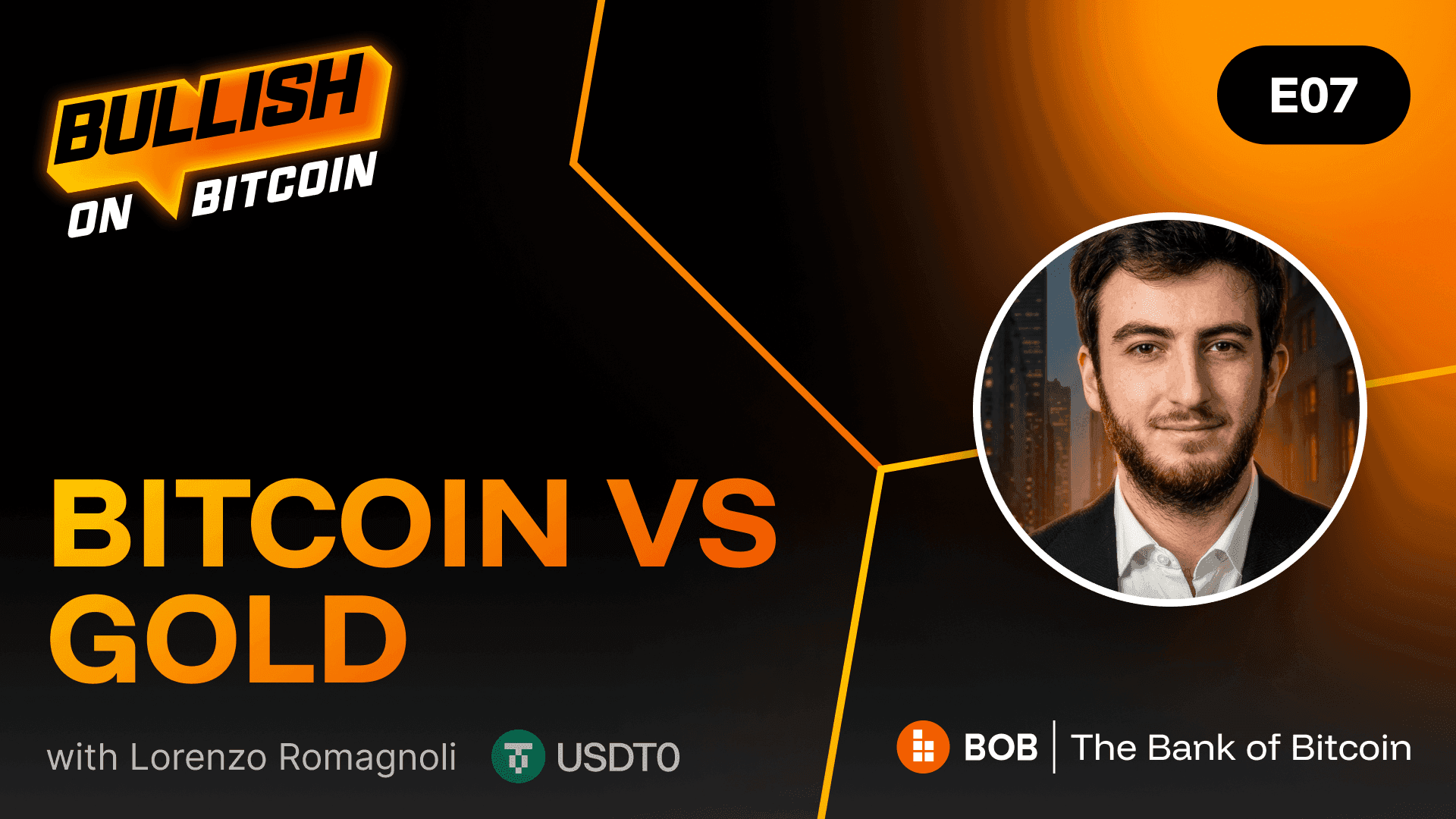
USDT0 co-founder Lorenzo on $100bn in 525 days, why Tron still wins, Open USD vs Circle, tokenized gold overtaking dollar stablecoins, and Bitcoin culture.
In the latest episode of the Bullish on Bitcoin Show, BOB co-founder Alexei Zamyatin hosted Lorenzo Romagnoli, one of the co-founders of USDT0. He described himself in the first minute as a gold bug and a Bitcoin maxi, which turned out to be the honest preview: this episode goes from stablecoin market structure to tokenized gold to a long, unusually candid argument about what Bitcoin culture has cost the industry.
Lorenzo has been in DeFi since late 2020 and spent three years working on Tether products before this one - the native deployment standards on Celo and TON, and Alloy, the Tether product that let you collateralize a stablecoin with tokenized gold. USDT0 has been full-time for the last two years.
Here's a rundown of the highlights.
$100 billion in 525 days - and who's actually moving it
USDT0 launched by processing $100 billion in 525 days, which makes it the fastest-growing stablecoin interoperability platform in crypto. It launched in January 2025 and they weren't expecting this.
The interesting part is the shape of that volume, which they spent months digging into. Because USDT0 moves any size of USDT between chains for no fee, it's an ideal tool for size: hedge funds farming across platforms, whales relocating treasuries from Arbitrum to Polygon, and centralized exchanges rebalancing - Binance, Kraken and OKX among them, moving billions a month.
But the transaction count tells a different story, and it mirrors Tether's own distribution almost exactly. A tiny number of addresses move most of the dollars. The overwhelming majority of transactions are between zero and a thousand dollars. Volume has plateaued at roughly a billion a week; unique users and transaction counts have climbed steadily for six months straight.
His read on that divergence: while the rest of crypto slows down, stablecoin usage doesn't, because it was never really part of the same cycle.
Stablecoins weren't built for us
Both had the same conversion story, in different cities. Alexei was at LABITCONF in Argentina, where withdrawing from an ATM carried rates he described as something Europeans have simply never seen, and USDT-for-cash was the only sane option. Lorenzo arrived in Bogotá with no cash at all:
“I just sent TRC-USDT to a guy. And then forty-five minutes later he was in the lobby of my hotel with a bag of cash.”
From which he draws the line he says he'll go to his grave repeating:
“Stablecoins were not meant and were not built for us. And when I say us, I talk about people that live in Europe, in the US, very highly banked countries.”
He's watched it firsthand in Tanzania, where people have M-Pesa or they have USDT, and asking which chain it's on produces blank confusion. They want dollars. It happens to be riding on Tron. That, he argues, is why Tether is at roughly $180 billion while everyone else sits nearer $80 billion - it went after the people who actually need it, and that turned out not to be a niche.
Why Tron still wins, and what would break it
Alexei's spicy question: Tron's whole pitch was that it was the cheap alternative, and fees there have climbed to the point where it isn't. Ethereum L2s and newer chains like Plasma offer near-free stablecoin transfers. Why does Tron still dominate?
Lorenzo put the cost of moving USDT in and out of Tron through their products at around $40 - “which is crazy, because we charge basically no fees.” And still, in his view, not enough to move anyone. People saving in USDT, stockpiling it in their own addresses, bundling transactions together, absorb it.
The reason is that Tron's strength isn't crypto-native at all. It's merchants, OTC desks, and cash-to-USDT services staffed by people who are not crypto people in the slightest. They switch when the pain of the fees exceeds the pain of switching, and not before. His prediction is that this doesn't happen gradually:
“There is going to be an indifference point at which all of those users will shift away all in one go.”
Which puts the burden on everyone else to be ready when it arrives - not with a better chain, but with the peripheral infrastructure that onboards merchants and non-crypto users.
Dollars, gold or Bitcoin?
The titular question, and Lorenzo answered it with his own portfolio. He's 26, started buying at 20, and has put every crypto dollar he's made into the same three things in the same proportions since: 75% Bitcoin, 12.5% dollars, 12.5% gold.
His framing is that the question contains a false fight. Gold isn't competing with Bitcoin - gold is competing with the dollar. When people losing 40% a year to their local currency work out that the dollar is also a fiat currency that loses purchasing power, they'll look for something else. Bitcoin isn't ready to absorb them; it's too volatile and the system around it isn't built for hundreds of millions of newcomers. Gold is ready, and has been for a while.
His evidence is a line from his second-year macroeconomics professor that he's clearly been carrying around ever since: an ounce of gold in the Roman Empire bought you a sword, a tunica and a pair of sandals. An ounce of gold today buys you a gun, a t-shirt, trousers and a pair of sneakers.
“That's what maintaining purchasing power means. We're not talking about a hundred years, we're talking about a couple thousand years.”
And if an asteroid full of gold ever turns up, he added, that's what Bitcoin is for.
What Bitcoin has that no stablecoin can
Lorenzo was unusually direct about the limits of his own product. USDT0 and XAUT0 process freeze requests from law enforcement roughly once every two days, because they are a company and companies comply with the laws of man. When the FBI says a victim's funds were stolen, he freezes them - he can, he has to, and he will.
Which is exactly why he holds Bitcoin:
“If I'm trying to escape from a dictatorship, I'm not going to keep my money in a centralized stablecoin. Probably I'm likely going to keep them in Bitcoin, because come and freeze it, come and get it.”
He has the personal reference points for it - friends with frozen bank accounts, friends who left Ukraine when the war started and could carry nothing across the border except Bitcoin on a Ledger. The principle he keeps coming back to, which he attributes to Paolo or possibly someone else: no person should ever work for something another person can simply create.
The argument about Bitcoin culture
The last third of the episode was two people who like Bitcoin being frank about what its loudest faction has cost it.
Lorenzo lives in Lugano, home of the Plan B forum. He pays his office in Bitcoin Lightning, largely because he put the stickers on the point-of-sale terminals and now feels obliged. He trains with Giacomo Zucco and counts laser-eyed maximalists among the people he respects most - he understands where the position comes from, having watched the same parade of scams everyone else did.
What frustrates him is the reflex against anything else. Ordinals made him happy: usage, miners earning fees, and the possibility of building an NFT on Bitcoin rather than Ethereum. The response was that he was filling the blocks.
“You cannot tell me, as a laser-eyed maxi, that the technology Aave brought to the market isn't what Bitcoin used to stand for. Open, permissionless, non-custodial finance.”
And when the answer is “yes, but it's on Ethereum” - well, yes, because you can't build it on Bitcoin. Alexei matched him with his own. He was uninvited from Bitcoin conferences for talking about anything beyond holding, refused a speaking slot in Innsbruck, and watched what he calls the dark ages after the block size wars push a generation of researchers out into Ethereum and other ecosystems.
Both agreed it's much healthier now. Ethereum and Solana aren't dismissed as scams; zero-knowledge work done elsewhere is being brought back to Bitcoin. What Lorenzo wants is the older register of advocacy - the Antonopoulos version, which he first met through The Internet of Money and describes, without embarrassment, as the closest thing to a god he's had in his life. Not “borrow money to buy Bitcoin”, but “spend your time understanding what Bitcoin actually is”:
“Either you're always buying Bitcoin, or you're not ready to even buy Bitcoin only once.”
Alexei's closing note was that the extreme camp doesn't actually determine what happens. Builders build, users arrive, and Bitcoin - with a bigger brand than Apple - remains the most effective wedge for bringing the next billion people on-chain.
Watch the full episode
This recap covers the main threads, but the full conversation goes deeper on USDT0's origins inside the Tether product stack, the mechanics of chain launches and pre-deposit vaults, and where stablecoin competition goes from here. Watch the complete episode of the Bullish on Bitcoin Show with Lorenzo here:

Maria Nimfuehr
Growth marketing lead
Marketing and GTM engineer at BOB. Previously at Lisk. Mentor at Techstars.