·7 lectura mínima
Anchorage Digital: Nathan McCauley & David Lawant on Institutional Bitcoin and Agentic Finance

Petra Poliaková
Events Manager
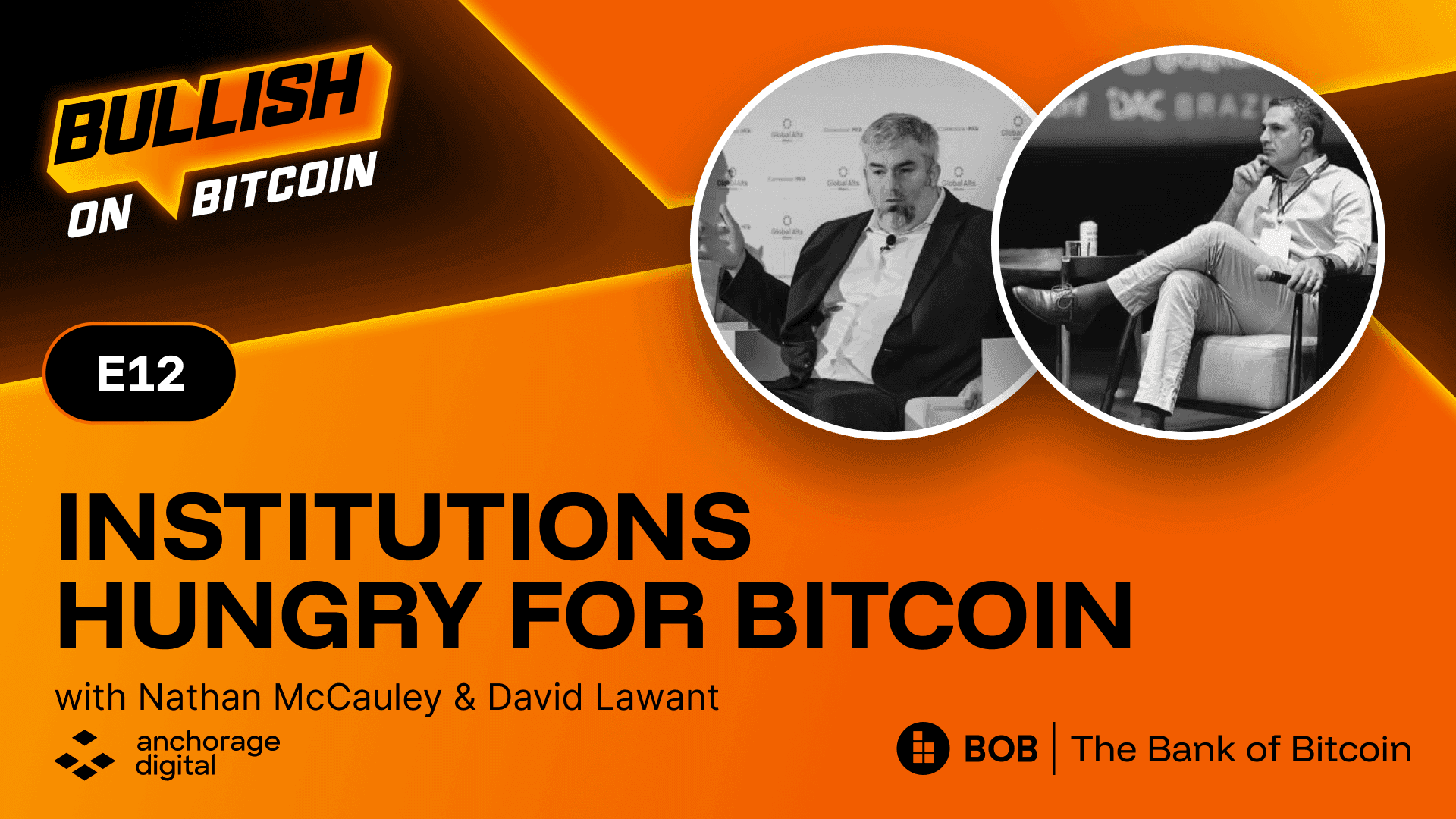
Anchorage Digital's Nathan McCauley and David Lawant join Alexei Zamyatin to discuss institutional Bitcoin custody, yield, and agentic finance.
In episode twelve of the Bullish on Bitcoin Show, BOB co-founder Alexei Zamyatin spoke with Nathan McCauley, CEO and co-founder of Anchorage Digital, and David Lawant, Head of Research — two guests with very different paths into Bitcoin, but a shared front-row seat to how institutions actually hold and use it today. The conversation covered why Anchorage Digital bet early on regulated custody, how institutional Bitcoin activity has quietly moved well past simple buy-and-hold, the retail custody gap exposed by a recent hardware wallet security incident, and a substantial closing stretch on what it will actually take for AI agents to transact with money.
Here's a rundown of the highlights.
Betting on Regulation Before It Was Obvious
Nathan McCauley described coming to Bitcoin later than many peers, drawn in once Ethereum showed that blockchains could be more than a store of value — they could be a compute layer. That insight led him and his co-founder to a simple thesis: institutional adoption of this new asset class was inevitable, and it would require a regulated institutional counterparty to make it possible. David Lawant's path ran through traditional equity research and a self-described "gold bug" phase before Bitcoin gradually won him over as a legitimate competitor to gold — a journey that later took him through Bitwise Asset Management and FalconX before landing at Anchorage Digital.
Alexei raised the tension at the heart of Anchorage Digital's positioning: choosing the regulated path opens doors with institutions but can invite skepticism from Bitcoin purists. Nathan pushed back on the idea that this creates any real conflict, pointing to Hal Finney's early writing on the Bitcoin Talk forums, where Finney predicted most Bitcoin would eventually be held at banks:
"If we want institutional adoption, if we want this asset class to grow infinitely, then we need it to be for everyone... institutions have to use a third-party custodian, both legally and for the operational realities of how their business operates."
He described Anchorage Digital's strategy as walking a tightrope — staying broadly neutral across assets while investing deeply in specific ecosystems the team believes in.
Lessons for Crypto Startups Going the Regulated Route
Alexei asked what advice he'd give founders now trying to follow a similar path — moving from pure on-chain DeFi toward bank-like positioning, credit cards, and fiat rails — Nathan’s answer centered on staying client-obsessed from day one: talk deeply to the institutional allocators you want to serve before building the compliance stack, so the enormous effort of becoming regulated is spent building something that actually resonates. His second piece of advice was more philosophical — that regulatory complexity is learnable, especially now that AI tools make research and self-education dramatically more accessible than when Anchorage Digital was founded.
Alexei connected this to a broader market shift: on-ramping used to be a genuine moat (MoonPay's early dominance being the clearest example), but the rise of easily obtainable licenses and low-fee stablecoin on-ramps has eroded that advantage across the industry.
From Digital Gold to Productive Asset
Alexei asked where institutional Bitcoin adoption actually stands today, Nathan pointed to a milestone moment: asset managers who were once laughed at for even considering holding Bitcoin are now Anchorage Digital clients, and the firm has recently taken in roughly half a percent of all Bitcoin in circulation. The more interesting shift, he said, is the growing appetite to turn Bitcoin from a "gold-ish" asset into a productive one — through yield, experimental staking protocols, and derivative strategies.
David backed this up with market-structure data: Bitcoin's options market has grown more than tenfold over the past two years even as the spot price moved comparatively modestly, and trading activity has meaningfully shifted toward ETFs rather than spot exchanges or perpetual futures. He described a market that's grown far more complex — populated now by delta-neutral funds, systematic desks, and a much wider range of investor types than the simple spot-and-futures picture of just a few years ago.
Options Dominate the Yield Conversation
Alexei pressed on which institutions are moving fastest into Bitcoin yield strategies, David pointed squarely to options as the dominant approach — a shift from the degen, directional-bet options market of a few years ago toward a more sophisticated tool that treasury companies, miners, and specialized hedge funds now use to extract yield on large Bitcoin holdings. He flagged one structural limit on this market's growth: flows remain largely one-sided, since relatively few participants want to take on Bitcoin-denominated liabilities given the asset's volatility, which keeps the credit market smaller than the pure yield-extraction side.
The Exotic Ask: DeFi Access Without Giving Up Custody
Alexei asked about the most surprising recent client requests, Nathan described a clear pattern: institutions increasingly want their Bitcoin to remain inside Anchorage Digital's custody while still being usable as collateral on perpetual-futures DEXs elsewhere — full access to DeFi's benefits without leaving qualified custody. He called it clients wanting "to have it all."
Alexei highlighted a concrete example of this in action: Anchorage Digital's collaboration with Lombard, where Bitcoin is custodied at Anchorage Digital, earns yield through a strategy run by Bitwise, and the resulting position can still be used as collateral on perpetual DEXs. Nathan agreed it's a clean illustration of stacking all three institutional priorities — safety, yield, and liquidity — in a single product.
The Cold Card Incident and the Retail Custody Gap
The conversation turned to a real concern on Alexei's mind: a recent security incident affecting Cold Card hardware wallets, and the resulting uncertainty among retail holders about where Bitcoin should actually be kept if hot wallets, exchanges, and now hardware devices all carry meaningful risk. Nathan was candid that this reflects a genuine, unresolved problem — exposing raw private-key management to people who may not be technically equipped to handle it safely — and said his personal bet is that more Bitcoin will migrate to institutional holders over time, integrated the way a stock investment already is, without requiring ordinary people to manage hardware themselves.
Importantly, Nathan was clear that Anchorage Digital has no ambition to become a retail-facing product itself. Instead, the company's strategy is to be the regulated back end that lets other institutions — banks, brokerages, retirement platforms — offer Bitcoin exposure to their own retail clients safely, without re-hypothecating assets.
Alexei offered a personal reflection here, admitting some discomfort recommending an ETF to friends who ask how to hold Bitcoin, given his years working on non-custodial solutions — but conceding that an institutional custodian in the background is probably the most realistic answer today, even if it still feels slightly at odds with crypto's original self-custody ethos. David added a forward-looking data point: some Bitcoin ETF issuers have begun lowering thresholds for in-kind redemptions, similar to gold ETFs that already allow physical withdrawal — a small but meaningful sign of further innovation still to come.
Agentic Finance: Payments, Guardrails, and "Know Your Agent"
The episode closed on a long, substantive discussion of agentic finance. Alexei cited a Bitcoin Policy Institute study finding that large language models, when asked about hedging against inflation, tend to recommend Bitcoin — and, more surprisingly, rank Bitcoin ahead of traditional banking (behind stablecoins) as a remittance and settlement rail.
Nathan argued agents themselves won't be ideologically opinionated about payment rails — they'll gravitate toward whatever is cheapest, most reliable, and best designed for their use case, whether that's Bitcoin, stablecoins, or a traditional card. He described Anchorage Digital's own agentic banking build-out around a core belief: agents need the ability to both pay and get paid, across cash, card, and crypto, in order to have genuine financial sovereignty.
Alexei suggested that AI agents' lack of emotional attachment could actually make them better traders than humans in some respects — no reluctance to sell out of a favorite early investment — but flagged hallucination and prompt injection as real, unresolved risks.
Nathan drew a comparison to the long, incremental rollout of self-driving cars: trust in agentic finance will likely build gradually, starting with small amounts of delegated capital and expanding as consistent, safe behavior accumulates over time. He also raised an underappreciated angle — agents may end up protecting people from bad financial decisions (unwanted subscriptions, poorly understood commitments) better than people protect themselves.
David added that "human in the loop" oversight is currently a limiting factor on how much value agentic trading can capture, comparing the current approval-heavy workflow to how developers already work with AI coding tools — tuning permissions rather than granting full autonomy. Both agreed the more promising near-term framing is "human in the loop": configuring limits once and monitoring rather than approving every action.
Nathan connected this to Anchorage Digital's "Know Your Agent" concept, describing an approach where agents build a form of credit and reputation over time, similar to how a bank underwrites a person or company based on consistent transactional history — potentially even exploring legal-entity-like structures for agents down the line. Alexei raised a complementary concern: guardrails need to protect not just against a legitimately untrustworthy agent, but against a trustworthy agent running on compromised infrastructure — a distinction he compared to needing a firewall layered on top of any reputation system.
Watch the Full Episode
This recap covers the main threads, but the full conversation goes deeper on Anchorage Digital's approach to budgeting agent spending across payment rails, the mechanics of the Anchorage Digital-Lombard yield product, and where agentic commerce is headed next. Watch the complete episode of the Bullish on Bitcoin Show with Nathan McCauley and David Lawant here: