·7분 읽음
The Future of Bitcoin: Nic Carter (Castle Island) on US Policy, Soft Forks, and Bitcoin L2s

Petra Poliaková
Events Manager
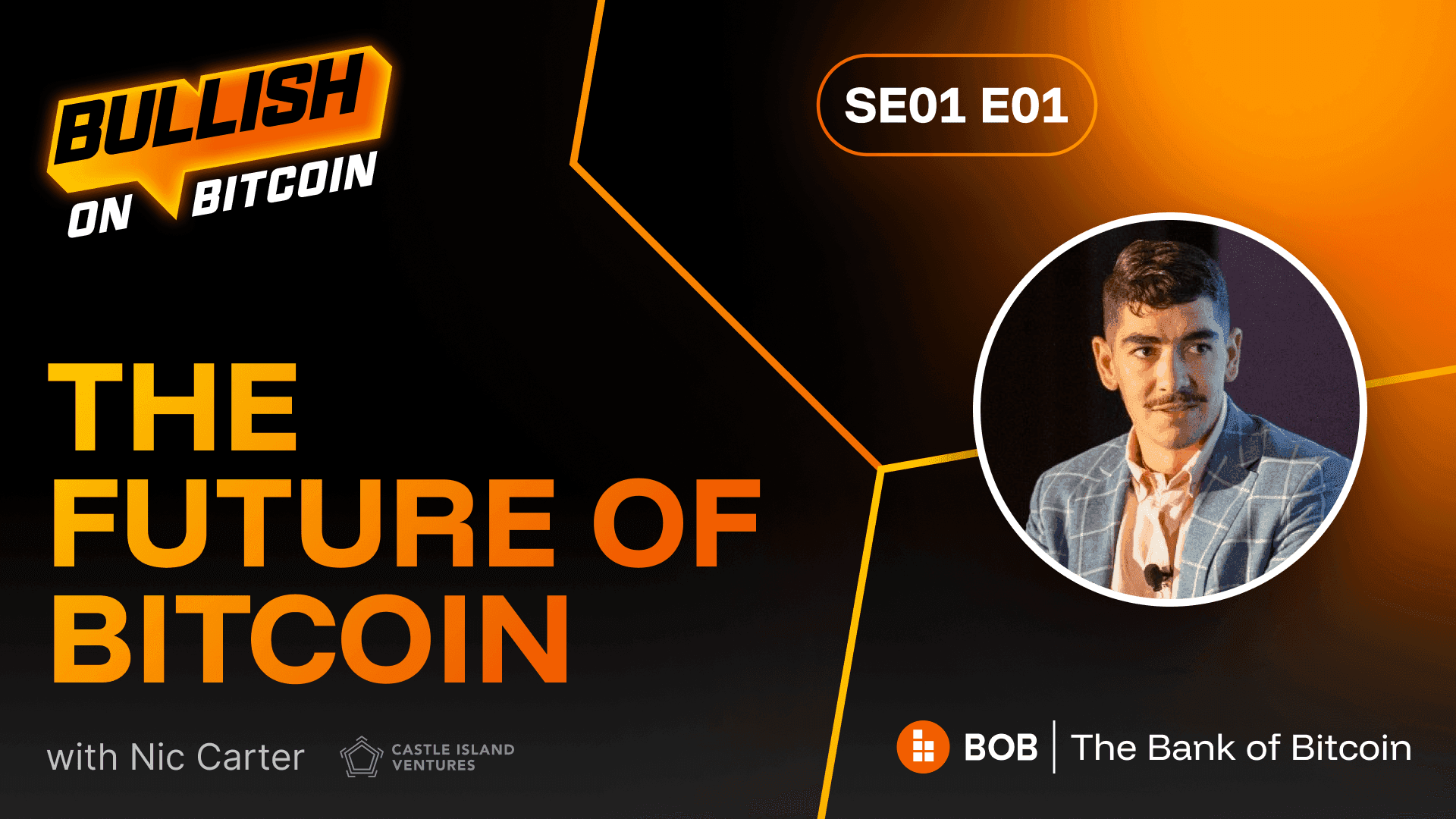
Castle Island's Nic Carter joins Alexei Zamyatin to discuss US crypto policy, the Bitcoin reserve, soft forks, and the future of Bitcoin L2s.
In this episode of the Bullish on Bitcoin Show, BOB co-founder Alexei Zamyatin sat down with Nic Carter, co-founder of Castle Island Ventures, founder of the blockchain data project Coin Metrics, and the person widely credited with coining the term "Operation Choke Point 2.0." Carter found Bitcoin through a Reddit ad around 2012, wrote what he describes as the first crypto dissertation at the University of Edinburgh, and went on to work on Fidelity's crypto team before launching Castle Island in 2018. The conversation covered the dramatic shift in US crypto policy, the debate over Bitcoin's strategic reserve, whether Bitcoin can still be upgraded, and what it will take for Bitcoin L2s to succeed.
Here's a rundown of the highlights.
A Policy Reset: "It's All Good"
Alexei asked how to interpret the turbulent last six months in US policy, Carter was clear that the developments exceeded even the expectations people had before the election. His list, in order of importance, started with the end of Operation Choke Point 2.0, the informal pressure campaign that cut crypto businesses off from banking. He pointed to a new FDIC chairman, an OCC memo confirming banks can work with crypto, and a new Fed vice chair for supervision. He also highlighted a proposed bill from Senator Tim Scott that would stop regulators from using "reputational risk" as a lever, the main mechanism behind the informal ban. Debanking might sound irrelevant to Bitcoiners who want to be their own bank, Carter said, but any entrepreneur starting a Bitcoin business in the US needs access to banking.
He also welcomed the SEC's changed posture, which makes it far more feasible to build DeFi products in the US, including on Bitcoin, and expects stablecoin and market structure legislation to follow. Another quiet but crucial unlock, he added, was the rollback of SAB 121, which had effectively blocked banks from custodying Bitcoin. In his view, the banks themselves want to offer Bitcoin products, as shown by the pause letters the FDIC sent to a number of banks in 2022 and 2023.
Reservations About the Strategic Reserve
Carter was candid that he opposed the idea of the US government buying Bitcoin. He worried it would be seen as a bailout and turn Americans against Bitcoiners, and that serious purchases could unsettle Treasury markets by raising questions about the dollar. He also argued that Bitcoin is not yet mature enough to back a currency, noting gold's market value is many times larger than Bitcoin's.
Still, he welcomed one aspect of the announcement: the split between a Bitcoin "reserve" and a "stockpile" holding other crypto assets, which distinguishes Bitcoin from everything else. His bigger concern was the risk of Bitcoin being seen as too American:
"We also have to be careful not to hug Bitcoin to death."
He cited comments from the Commerce Secretary about wanting a majority of Bitcoin mining to be onshored, which gave him pause. Carter described it as far-fetched, but worth being alert to, that governments might want influence over miners. Bitcoin's real value proposition, he argued, is its political neutrality.
Will Other Countries Follow?
Alexei asked whether US dominance might push other countries away, given that Credit Suisse had described Bitcoin as the one credibly neutral asset in a multipolar world. Carter drew a distinction between holding Bitcoin at the sovereign level and creating a friendly environment for crypto businesses. On the latter, he said regulators in Southeast Asia, Africa, and the Middle East are already taking cues from the US, which leads global financial regulation. On the former, he noted the UAE's sovereign wealth fund has bought some Bitcoin and that central banks have been selling dollars and buying gold, a trend that could benefit Bitcoin as a non-sovereign asset.
West vs. East, and Why 2025 Could Be the Year
Alexei described a split he sees in practice: retail users in the US and Europe are conservative with their Bitcoin, while retail in Asia-Pacific experiments with decentralized use. Institutions show the opposite pattern, with Western custodians and funds under pressure to generate yield on Bitcoin held in treasuries. Carter said he doesn't know exactly why Asia moved first with Bitcoin L2s and yield products, but suspects it comes down to the right products arriving with credible security. He predicted that this would be the year real Bitcoin DeFi launches, including real rollups on Bitcoin, and that trust among Western audiences would grow as a result.
Can Bitcoin Still Be Upgraded?
A major part of the conversation was the debate over new opcodes like OP_CAT and CTV. Alexei explained that he has become more sympathetic to pushing for upgrades sooner rather than later, since broader institutional adoption makes change harder. He used Lightning and Schnorr signatures as examples: improvements exist, but large custodians and wallets are slow to adopt anything that adds overhead.
Carter agreed that institutions are naturally slow to change, noting the Bitcoin address your custodian gives you is often still a legacy format. He said any upgrade has to be developer-driven, since asking BlackRock, governments, and large holders for permission would never produce consensus. He also pointed out that the largest holders are often the ones most strongly opposed to changing the protocol. His observation on soft fork timing was blunt: the gap between upgrades has been growing, and if the pattern continues, the next might not arrive until around 2030, which is why BitVM matters. Alexei added that he considers BOB willing to use any upgrade it can get, but that betting a business on a soft fork is not realistic:
"Betting on a soft fork is like going to the casino at this point."
Carter agreed, noting that businesses built around anticipated Bitcoin changes, including some around Lightning and SegWit, did not work out as hoped:
"You can't predicate what you're building on any change to Bitcoin."
Bitcoin L2s and the Security Budget
Carter relayed a question from a large institutional custodian: will Bitcoin L2s actually change the economics for miners, or will block rewards remain around 99% of miner revenue? Alexei gave both a "marketing answer" and a "realistic answer." In theory, rollups posting data to Bitcoin would drive up fees, and a report from Galaxy Digital modeled this. In practice, posting data to Bitcoin today would make L2s 100 to 1,000 times more expensive than Base, Arbitrum, or Solana, and users won't pay $10 for a swap that costs cents elsewhere. His framing:
"I think we should see Bitcoin L2s as startups."
That means scaling first and generating sustainable revenue later. He sees a mix of middle-ground solutions in the meantime, including Bitcoin staking (which many miners participate in), merge mining, and data posted elsewhere, with full Bitcoin rollups as a later phase on BOB's roadmap. He expects Bitcoin fees to rise over the next three to four years as experimentation grows.
Carter offered a helpful comparison with Ethereum: it took roughly two and a half years from the first rollups for them to match mainnet's transaction throughput, and today they handle far more than Ethereum's base layer. Scaling, in other words, is not overnight.
How Secure Are Bitcoin L2s Today?
The two discussed L2BEAT's staged framework for rating rollups, noting that most Ethereum L2s are still at stage zero or one. Carter observed that despite this, tens of billions of dollars are secured and people use them anyway. Alexei acknowledged that none of today's Bitcoin L2s are truly Bitcoin-secure yet. He said BOB was in its bootstrapping phase, planning to add Bitcoin staking security through a hybrid design later that year, and aiming for stage one within six to twelve months. Since stage two would require validity proofs that Bitcoin can't verify without a fork, BitVM-based optimistic designs are the best available today. He also argued that public scorecards create healthy pressure, because gradual decentralization otherwise tempts teams to skip costly security upgrades once users are comfortable.
What the Reserve and ETFs Mean for Bitcoin L2s
In closing, Alexei asked whether the strategic reserve helps Bitcoin L2s. Carter said Bitcoin has had two defining legitimacy moments: the launch of ETFs, which put it in the legacy financial system, and the reserve announcement, which separated Bitcoin from all other crypto assets. He downplayed the likelihood of large government purchases, but said the "seal of approval" matters most, and expects more blockchains to rely on Bitcoin security and more teams to try building DeFi on Bitcoin.
"Bitcoin is in a class of its own."
Alexei agreed, calling Bitcoin's brand comparable to Apple's, and argued that Bitcoin L2s should learn from Ethereum's UX improvements, which matter even more for retail Bitcoin holders than for DeFi power users. Lightning, he said, shows what happens when technology is superior but hard to use:
"You have to go to where the users are and not expect them to come to you."
Carter agreed that Lightning, despite a lot of effort, wasn't the success many hoped for, and that it's important to learn from the data. With dozens of Bitcoin L2s now trying to tackle Bitcoin's usability problem, Alexei said he feels BOB has a good shot at solving it.
Watch or Listen to the Full Episode
This recap covers the main threads, but the full conversation goes deeper on the origins of Carter's Bitcoin journey, the OP_CAT versus CTV debate, and how L2 security is measured. Catch the complete episode of the Bullish on Bitcoin Show with Nic Carter on your platform of choice: